- 29-10-2026
From Classroom to Career: Essential Tech Skills Every Student Should Learn in 2026
The technology industry is evolving rapidly, creating exciting opportunities for students who are willing to learn, build, and adapt. But with so many programming languages, frameworks, and tools available, knowing where to start can feel overwhelming.
Whether you are pursuing computer science, information technology, or another technical degree, building the right skills can help you move confidently from academic learning to real-world opportunities.
1. Master the Fundamentals of Programming
Before jumping into advanced frameworks, develop a strong foundation in programming. Learn one language well, such as Java, Python, or C++. Focus on problem-solving, object-oriented programming, data structures, and algorithms.
These fundamentals will help you understand new technologies faster and prepare for technical assessments and interviews.
2. Learn Web Development and Backend Engineering
Understanding how applications work behind the scenes is a valuable skill. Start with HTML, CSS, and JavaScript, then explore a backend framework such as Spring Boot or Django.
Learn how REST APIs work, how databases store information, and how authentication protects applications. Build projects that connect a frontend, backend, and database instead of relying only on tutorials.
3. Understand Artificial Intelligence and Its Practical Uses
AI is becoming part of software development, education, data analysis, and many other fields. Students can begin by understanding the fundamentals of machine learning, large language models, and responsible AI use.
Experiment with AI APIs and build useful applications, such as a study assistant, document summarizer, or personalized learning tool. Focus on understanding the technology rather than simply copying AI-generated code.
4. Build Real Projects That Solve Problems
Projects help demonstrate what you can actually do with your knowledge. Instead of creating several identical basic applications, choose a problem and develop a solution with meaningful features.
For example, build a student productivity tracker, an online learning platform, a coding progress dashboard, or an application that helps users organize their study schedules.
Document your work on GitHub, write a clear README, and explain the decisions you made during development.
5. Learn Git, Databases, and Deployment
Software development involves much more than writing code. Learn Git and GitHub for version control, SQL for working with relational databases, and the basics of deploying applications to a server or cloud platform.
Understanding testing, debugging, security, and application performance will also help you develop more reliable software.
6. Prepare for Internships and Technical Interviews
Start preparing early rather than waiting until your final semester. Practice coding problems consistently, revise core computer science subjects, and prepare to explain your projects clearly.
Your preparation should include:
-
Data structures and algorithms
-
Object-oriented programming
-
DBMS and SQL
-
Operating systems and computer networks
-
Project architecture and technical decision-making
-
Communication and problem-solving skills
Consistency matters more than trying to learn everything at once.
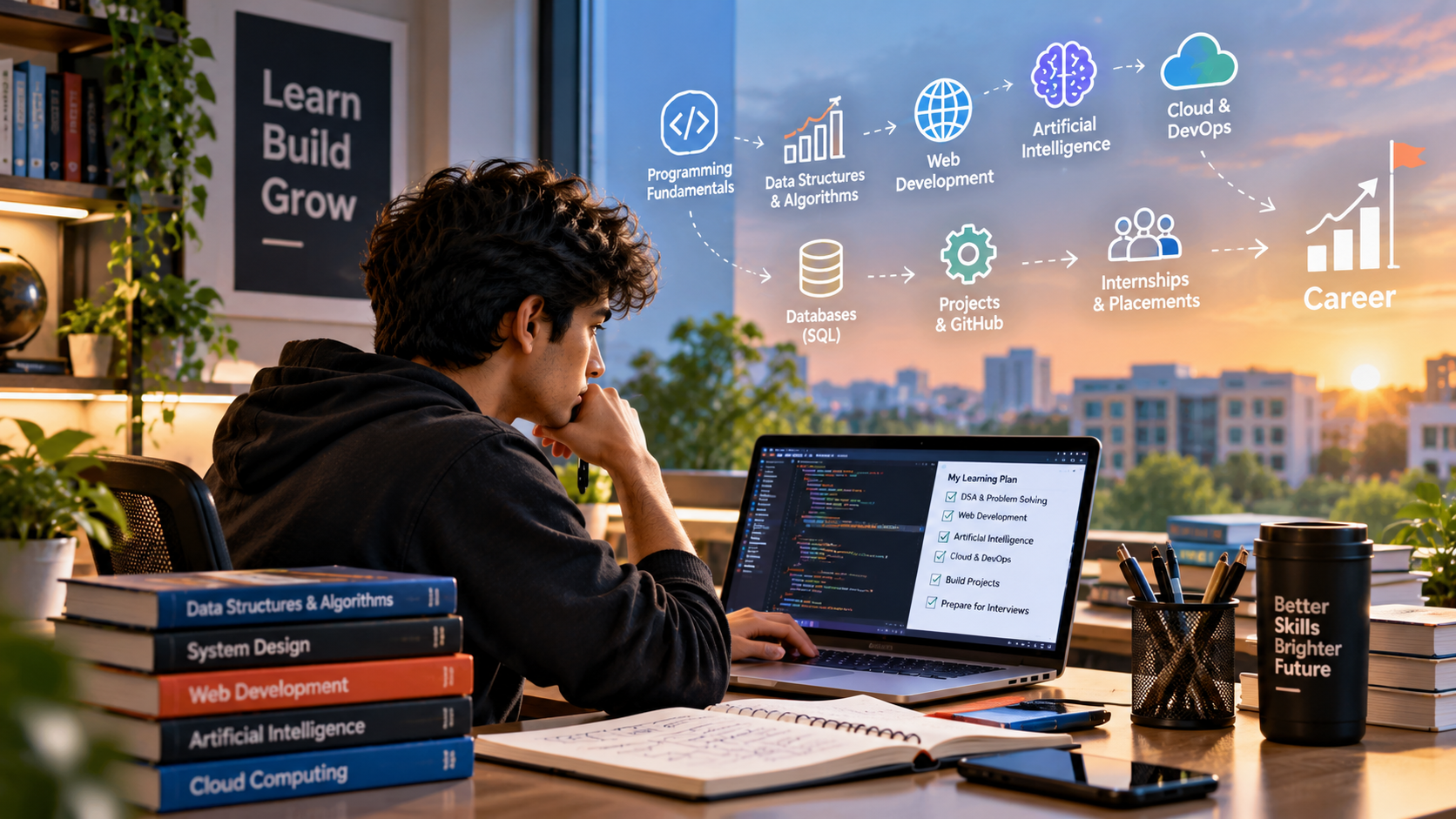
7. Follow a Practical Learning Roadmap
A simple starting plan can make your learning journey easier to manage.
Month 1: Strengthen programming fundamentals and problem-solving.
Month 2: Learn backend or frontend development and build a small application.
Month 3: Add a database, testing, authentication, and deployment to your project.
Month 4: Improve your portfolio, practice interviews, and apply for internships and entry-level opportunities.
Adjust this roadmap to your existing knowledge, available time, and career goals.
Final Thoughts
Building a technology career is not about mastering every new tool. It is about developing strong fundamentals, applying what you learn, and continuously improving through practical experience.
Start with one skill, build something useful, seek feedback, and keep going. Every project you complete can bring you one step closer to your career goals.
Keep learning. Keep building. Keep growing with TechViista.